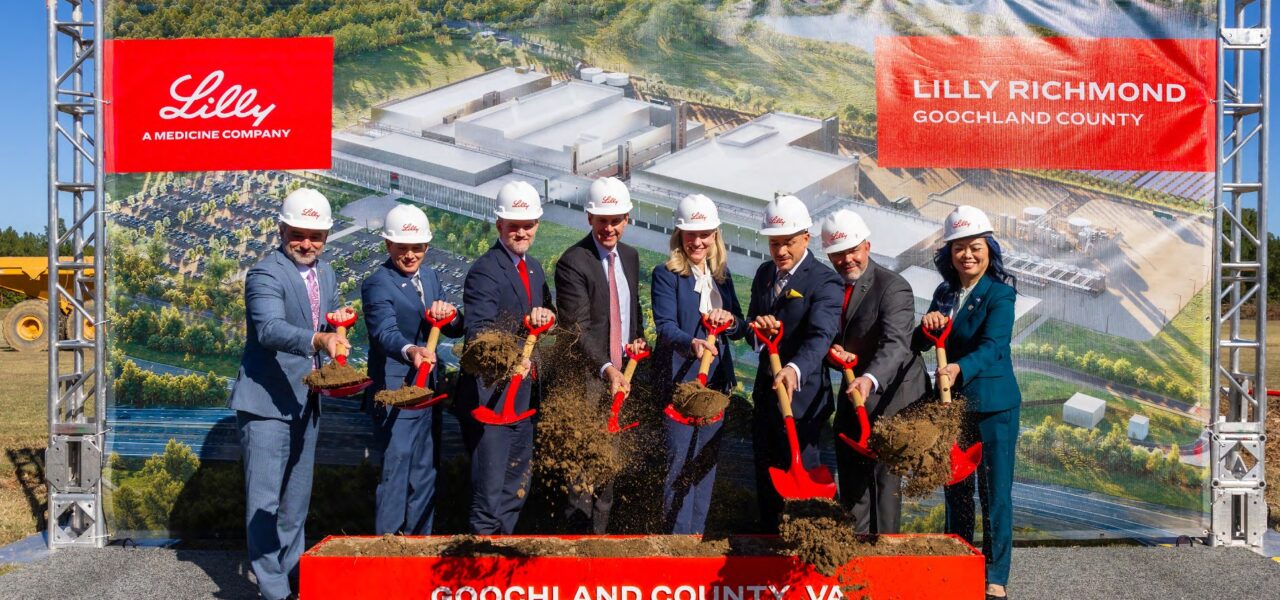
Photo Credit: Eli Lilly
With hiring underway, a state training center targeting 2028 and first production planned for 2030, Lilly’s Richmond site sets the clock on one of the region’s most significant biomanufacturing workforce builds.
Eli Lilly and Company’s groundbreaking in Goochland County, just west of Richmond, was largely framed around its headline figures: a $5 billion facility, the latest of 10 U.S. manufacturing sites Lilly has announced since 2020, and a marker in the company’s more than $50 billion domestic manufacturing push.
For Virginia’s life sciences workforce, the more consequential detail is the timeline that started this week. Lilly expects the site to create 650 high-wage jobs, including engineers, scientists, operations personnel and lab technicians, along with roughly 1,800 construction jobs as the facility is built and brought online. The company is already hiring, a statewide training network it helped fund is targeting a hands-on training center in Goochland County by 2028, and Lilly aims to begin making medicine at the site in 2030. Training can prepare much of the production workforce. The experienced leaders and technical specialists needed to start up a plant of this size will largely have to be recruited into the region, and they will be recruited at the same time AstraZeneca, Merck and the Richmond–Petersburg manufacturing cluster are hiring for the same skills.
The groundbreaking comes about 13 months after Lilly selected the Richmond region from more than 400 proposals across 46 states, a decision Lilly CEO David Ricks attributed in part to Virginia’s skilled workforce. The project has since moved across two administrations, announced under Gov. Glenn Youngkin and now advancing under Gov. Abigail Spanberger, who called the investment “a powerful vote of confidence in Virginia, our people, and our ability to compete for the industries and good jobs that will shape our future.”
A Hiring Curve That Starts Now
Lilly is not waiting for the building to go up before it builds the team. According to Virginia Business, the company has hired between 15 and 30 people locally for construction management roles, and Edgardo Hernandez, Lilly’s executive vice president and president of manufacturing operations, said the company has more than 20 offers outstanding. Eric Arocho, Lilly’s highest-ranking executive in Virginia, leads the Goochland site.
The production timeline is aggressive by industry standards. Hernandez told the publication that facilities of this kind typically take about five years from groundbreaking to production, but Lilly’s goal is 2030 for its monoclonal antibody facility, with the drug product operation, covering vials, labeling and packaging, following in 2031. Richmond BizSense reports the project will be built in two phases on a 227-acre West Creek site, beginning with a 600,000-square-foot facility and later adding a 340,000-square-foot expansion.
That schedule shapes who gets hired, and when. Greenfield biomanufacturing sites typically staff in waves: engineering, project management, commissioning and qualification, automation and quality systems talent arrive first to design, build and validate the facility, while manufacturing operators, technicians and QC analysts are hired closer to startup so they can train on the equipment they will run. A training center opening in 2028 lines up with that second wave, roughly two years ahead of first production.
What an Integrated ADC Plant Asks of Its Workforce
The Richmond site will be Lilly’s first to produce both active pharmaceutical ingredients and finished medicines in one fully integrated facility, with dedicated API capacity for bioconjugate and large-molecule medicines. Its focus is antibody-drug conjugates, targeted cancer therapies that pair the precision of an antibody with a potent cytotoxic payload, and a modality also being explored for autoimmune disease.
That combination makes the site’s talent profile unusually broad. ADC manufacturing draws on biologics production, including cell culture and purification of the antibody; high-potency compound handling and containment for the payload; and conjugation chemistry that links the two. Integrating API and drug product under one roof adds aseptic fill-finish, packaging and the analytical and quality functions needed to release complex molecules. For professionals, that breadth means a wide range of entry points and career paths inside a single campus, from chemists and bioprocess engineers to quality specialists and manufacturing technicians.
Lilly also said the site will run on machine learning, AI, digitally integrated systems and advanced data analytics to drive right-first-time execution, with automation embedded throughout. In practice, that places data, automation and digital quality skills alongside traditional GMP experience in the site’s hiring needs.
Virginia’s Training Infrastructure Comes Into Focus
Lilly’s workforce commitment runs through the Virginia Center for Advanced Pharmaceutical Manufacturing, a statewide network of industry, government and higher education partners. Lilly has committed $40 million to the effort, matching commitments from AstraZeneca and Merck that together total $120 million, an investment BioBuzz examined when it was announced in November 2025.
The network brings together five universities, including Virginia Commonwealth University, Virginia Tech, the University of Virginia, James Madison University and Hampton University, along with the Virginia Community College System, and has been projected to train roughly 2,000 to 2,500 people a year, according to Cardinal News and Virginia Business. Lilly’s announcement adds a key detail that earlier reporting left open: the network’s pilot-scale, hands-on training center will be located in Goochland County, with a targeted 2028 opening.
The center builds on pathways already forming in Central Virginia. Brightpoint and Reynolds community colleges have added pharmaceutical manufacturing coursework, VCU offers a pharmaceutical engineering Ph.D., and VCU’s Medicines for All Institute helped seed Richmond-based Phlow Corp. Together with Merck’s $3 billion Rockingham County expansion and AstraZeneca’s $4.5 billion Albemarle County investment, the three anchor projects represent $12.5 billion in pharmaceutical manufacturing capital committed to the Commonwealth, alongside a broader cluster that includes Civica and Thermo Fisher.
Recruiting the Experienced Core
The training network is designed to build the production workforce, the operators, technicians and lab staff who make up much of a plant’s headcount. A startup of this scale also rests on an experienced core that training cannot produce on Lilly’s timeline: site and operations leaders, biologics and conjugation process experts, high-potency containment and EHS specialists, validation and quality leadership, and the engineers who commission and qualify the equipment. Those roles are needed in 2027 through 2029, before the first training center cohorts are ready, and most require a decade or more of GMP plant experience.
Central Virginia’s existing pool of that talent is small relative to the demand now arriving. Cardinal News, citing IBISWorld, counted fewer than 1,900 Virginia workers in brand-name pharmaceutical manufacturing. AstraZeneca, which broke ground in Albemarle County a year ago, is projecting production by 2029, and Merck’s Rockingham County expansion could be completed the same year. Together those two projects account for about 1,100 permanent roles drawing on the same senior talent on overlapping timelines.
Closer to Goochland, the Petersburg advanced manufacturing campus is also growing. Civica committed to 186 jobs at its Petersburg facility, AMPAC Fine Chemicals announced 156 as part of its expansion there, and Phlow’s current Petersburg postings include director-level engineering, quality control management and EHS roles, the same experienced profile Lilly’s startup will require.
That makes attracting and relocating experienced talent a central part of Virginia’s next growth phase, alongside training new workers. Lilly’s site leadership already reflects it: Arocho joined the Goochland project from New Jersey. For seasoned GMP leaders and technical specialists, the result is an unusual concentration of greenfield opportunities in one state, with the scope that comes from building a plant rather than inheriting one.
A Network-Wide Build With Regional Reach
The nearest deep pools of experienced biomanufacturing talent sit in the BioHealth Capital Region’s Maryland biologics corridor, Greater Philadelphia and Research Triangle Park. Those are also regions where Lilly is building. Goochland is one of five Lilly API sites announced since 2020, joining Huntsville, Alabama; Houston; and two sites in Lebanon, Indiana. Lilly’s broader network includes injectable and device sites in Research Triangle Park and Concord, North Carolina; Kenosha, Wisconsin; and Lehigh Valley, Pennsylvania, plus a genetic medicines site in Lebanon.
For experienced biologics, quality and engineering professionals across the corridor, that means sustained demand from multiple build-outs on overlapping timelines and more leverage in choosing where to take their careers. For employers and training partners, it raises the value of coordinating pipelines across state lines rather than competing within them.
Lilly is currently posting roles on its Richmond careers page and inviting candidates to join its talent community for future openings. With the construction clock now running, the next three years will test how effectively Central Virginia attracts the experienced core these plants need, and how quickly the 2028 training center can build the production workforce around it.