At the Cal Ripken, Sr. Foundation’s 14th annual College Season Tip-Off Luncheon, college basketball’s leaders agreed that budgets can buy talent, but not a team. Their lessons on character and mentorship carry straight into how Maryland builds its next life sciences workforce.
“He changed the trajectory of my life.”
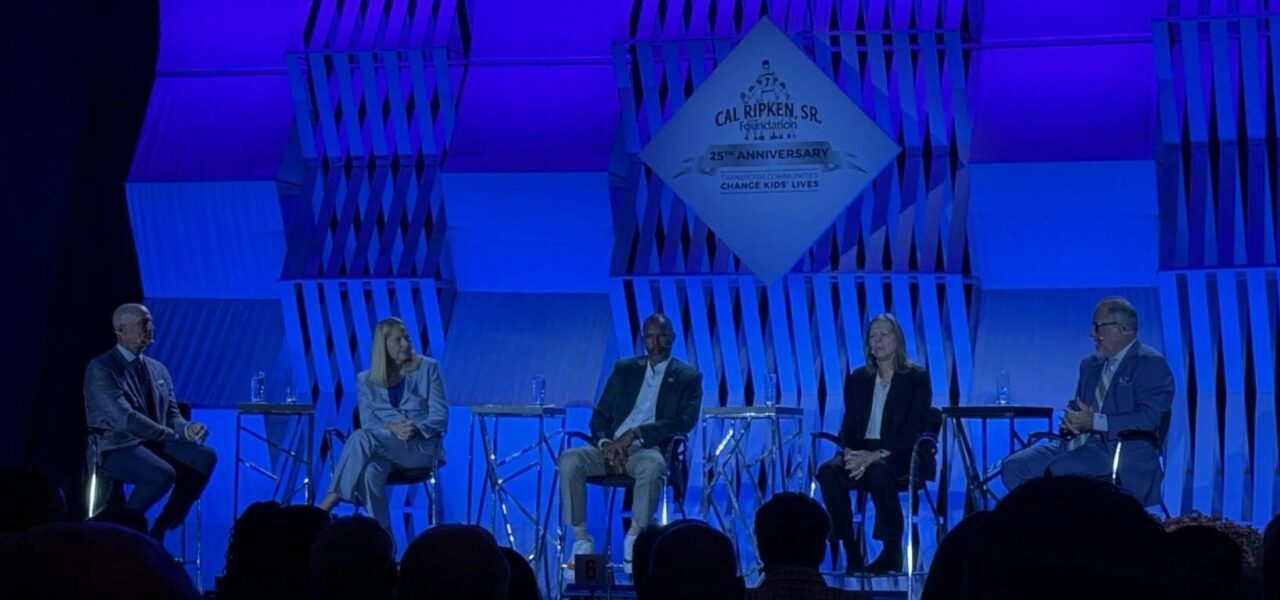
That’s how Maryland men’s basketball coach Buzz Williams described his mentor on stage at the Cal Ripken, Sr. Foundation’s 14th annual College Season Tip-Off Luncheon, held October 1, 2026, at the Baltimore Marriott Waterfront Hotel. It was a fitting line for an event built around a coach’s legacy. Cal Ripken Jr., Bill Ripken, and their family started the foundation in 2001 to honor their father, a lifelong coach and mentor. Organizers announced that this year’s luncheon raised more than $400,000 to further the foundation’s efforts in mentoring, Youth Development Parks, and STEM education, supporting kids in underserved communities in Maryland and across the country.
Joining Williams on stage were ESPN college basketball analyst Jay Bilas, Maryland women’s basketball coach Brenda Frese, Florida A&M men’s basketball coach and 1993 Heisman Trophy winner Charlie Ward, and Val Ackerman, the WNBA’s founding president, who retired as Big East commissioner in August. The panel covered the season ahead and how quickly college athletics is changing. But three ideas kept surfacing, and each will sound familiar to anyone building a team in life sciences.
Great Teams Aren’t Bought. They’re Built.
The panel’s clearest message was that money has changed who can assemble talent, but not what makes a team work.
Few people have watched that shift as closely as Ackerman, who led the WNBA from its launch. She compared women’s basketball in 1995 to today. Back then, she said, success wasn’t centered on who had the most money to build the best roster. Frese captured today’s reality in one line: “Final Four teams have Final Four budgets.” Panelists described a college game that increasingly resembles the NBA, with players drifting from the “student” side of student-athlete toward a more professional relationship.
Frese was also the most direct about where the new NIL money is going. She said she supports salary caps for both athletes and coaches, questioning why some college coaches, and even players, now earn more than NBA coaches. She also raised concerns that on some teams, players make more than their own assistant coaches.
Life sciences has its own version of this gap. Large pharma companies can often outbid startups for experienced scientists, and a well-funded company can build a deep bench quickly. Smaller biotechs across the region tend to compete on other things: the mission, the chance to grow, and the people new hires get to learn from. When budgets shape who gets the best talent, every organization has to decide what else it offers.
Character Is the Real Competitive Edge
Asked what they look for in a player, none of the panelists pointed to talent alone. Each named something money can’t buy.
For Ward, it starts with loyalty, the main thing he looks for in an athlete. That priority carries extra weight in an era when players can change teams for a better offer almost every season.
Williams framed it as a different kind of AI: information integrity and action integrity. Knowing the right thing and doing it are two separate commitments, and great teams need players who do both. He also tests motivation directly. To understand why a player is there and what gets them up in the morning, he asks: “Do you like ball, love ball, or live ball?”
Frese boiled down what she looks for to a few words: “Relationship, work ethic, think big, dream bigger.”
Loyalty, integrity, work ethic, drive: the words differed, but the pattern held. Each coach was describing what a person brings when the paycheck isn’t the reason they’re there. That lens translates directly to the lab. In a regulated industry, integrity in how data is handled and decisions are made is non-negotiable, and in a competitive hiring market, the people who stay are the ones invested in the work itself. Swap “ball” for science, and Williams’ question is a fair one for any candidate, and any hiring manager.
Mentorship Changes Trajectories, and It Starts Early
If character is what coaches look for, mentorship is how it gets built. It was the thread running through the whole afternoon, from Williams’ tribute to his own mentor to the coach the foundation is named for.
That belief drives the Cal Ripken, Sr. Foundation’s work. Its efforts rest on three pillars: youth mentoring programs like Badges for Baseball, which pairs kids with local law enforcement mentors; Youth Development Parks that give kids safe places to play; and its STEM Center Initiative. In 2025 alone, the foundation worked with schools, youth organizations, and law enforcement agencies in 580 communities across 45 states and Washington, D.C., reaching 1.6 million kids, according to the foundation.
For the life sciences community, the STEM work stands out. The foundation now has more than 910 STEM Centers in 31 states and Washington, D.C., reaching over 377,000 kids. The centers serve students from early childhood through high school, the years when kids often first discover what they’re interested in. Each comes stocked with hands-on tools like 3D printers and programmable robots, and the foundation trains teachers and mentors to use them throughout the year.
Many of those centers are close to home. A $3 million partnership with the Exelon Foundation set out to open 81 STEM Centers in communities around Baltimore, Washington, D.C., Philadelphia, Wilmington, Atlantic City, and Chicago, beginning with a new center at Lansdowne Middle School in Baltimore County. Speaking at that ribbon-cutting, Ripken Jr. said, “This is all about providing resources that will help kids learn.”
Why It Matters for Life Sciences
Building the future life sciences workforce starts long before college. The scientists, engineers, and manufacturing technicians Maryland will need in 15 years are in elementary and middle school right now. Whether they ever picture themselves in a lab often depends on someone showing them that it’s possible from the start.
That’s where organizations like the Cal Ripken, Sr. Foundation are laying quiet but important groundwork, and where life sciences companies have a natural role to play as partners, sponsors, and mentors. The coaches at the Tip-Off Luncheon were talking about basketball, but the lesson travels: the strongest teams are built by the people who invest in them, one relationship at a time.
The same idea drives BioBuzz’s BioCatalyst workforce program: you don’t need to be an industry expert to find a place in life sciences. You need a mentor, a community, and a first step. BioCatalyst brings employers, students, and the wider ecosystem together, including through Career Catalyst, a free weekly virtual series held Wednesdays at 6 PM ET. Each session pairs students, recent graduates, and early-career professionals with an industry expert for practical career guidance and a chance to connect with peers. The broader community will gather at BioCatalyst LIVE! on December 3 at 4MLK in the University of Maryland BioPark.
Learn more about the Cal Ripken, Sr. Foundation’s STEM Centers and how your organization can get involved.