Most medtech founders think about fundraising as a pitch. The ones who raise think about it as the result of how they build.
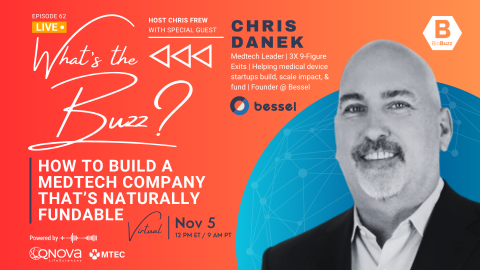
In this episode of What’s the Buzz?!, Chris Frew sits down with Chris Danek, Founder and CEO of Bessel, to unpack what it means to build a medtech company that’s “naturally fundable.” They cover why founders should look at their problem through an investor’s eyes, why fundraising is a matching process rather than a single event, how dual use and military medicine fit into a stacked capital strategy, and how to get real value out of JPM Healthcare Week — including the 13th Annual QNova LifeSciences Partnering Forum, January 11-14, 2027, at the Hilton San Francisco Union Square.
Bessel’s Build for Impact™ Cohort 5 kicked off this November. The paid, three-sprint accelerator helps US-based medtech startups, and those entering the US market, define and hit critical milestones and raise the right capital. It includes workshops on fundraising, strategy, and rapid innovation; office hours and master classes with Chris Danek; a Bessel AI Teammate customized to each startup; and a confirmed spot at the Build for Impact Startup Showcase during J.P. Morgan Healthcare Week 2027.
This episode of What’s the Buzz?! is presented in partnership with QNova LifeSciences, a global innovation and regulatory consulting group, and powered by Heffron Co., BioBuzz’s annual sponsor.
Recorded LIVE — November 5, 2026
Key Takeaways
- Naturally fundable is the end of a longer sentence: build toward a sustainable, scalable company, work backwards, and answer the questions that guide you. Those are the same questions investors need answered, and every risk you retire creates value.
- Don’t fall in love with the problem: Danek pushes past the familiar “fall in love with the problem” advice. Founders should first test whether a problem is worth solving — market size, competitive advantage, and “can I get paid for this?” — through the eyes of an investor who has seen the whole story many times.
- Start with guiding lights, then test cheaply: before a full target product profile, define about five guiding lights (clinical outcomes, workflow, stakeholder economics, business fit, IP), then iterate solution concepts and test them as quickly and cheaply as possible.
- Find the investors already looking for you: investors must be highly selective and usually have a specific profile in mind. A rejection can mean the fit is wrong, the timing is wrong, or the process needs work.
- Fundraising is a process, not an event: treat it as matching and relationship building, and seek the right capital at the right time for your stage.
- Dual use is a real capital strategy: military medicine is shaping solutions earlier but can’t fund captive products alone. With medtech often taking around 12 years from inception to exit against a typical 10-year venture fund life, founders need to stack and sequence capital — SBIR, NIH, military medicine, the VA, and rare disease foundations.
- Show up to JPM prepared: the QNova LifeSciences Partnering Forum is free for startups and works as a home base during JPM week, but Danek advises booking two or three committed, high-value meetings in advance and inviting your own investors to meet you there.
- Credibility compounds year over year: investors like to “look over your shoulder.” Founders who return each year and show they did what they said they would build the trust that leads to funding.
Guest Bio
Chris Danek, PhD, MBA
Chris Danek is Founder and CEO of Bessel, where he helps medtech founders define and hit the critical milestones that let them raise the right capital. He holds a PhD in mechanical engineering from Stanford and an MBA from Wharton. Over decades in engineering, executive, and founder roles, he led development of the first FDA-approved interventional treatment for asthma and co-founded AtheroMed, developer of the Phoenix Atherectomy System, later acquired by Philips. At Bessel he created the Build for Impact™ accelerator, the Bessel Origin program, and a train-the-mentor program.
→ Connect on LinkedIn: https://www.linkedin.com/in/chrisdanek/
About Bessel
Bessel helps medtech founders build for impact so they become naturally fundable and naturally acquirable. Its Build for Impact™ accelerator has worked with more than 30 companies, one-on-one and in cohorts, and is opening its fifth cohort. Cohorts usually include six to eight companies. They combine workshops, peer founder circles, pitch practice, collateral support, and curated investor introductions. Each program ends with a Build for Impact Showcase during JPM Healthcare Week. Partners have included Hatch Fairhope in Alabama (supported by Innovate Alabama), Connect Labs by Wexford in Baltimore, and Aggie Square in Sacramento (Wexford and UC Davis). Bessel is a Platinum Sponsor of the QNova LifeSciences Partnering Forum and an MTEC M-Corps Service Provider.
About QNova LifeSciences
QNova LifeSciences is a global innovation and regulatory consulting group that advances therapeutics anBessel’s Build for Impact™ Cohort 5 kicked off this November. The paid, three-sprint accelerator helps US-based medtech startups, and those entering the US market, define and hit critical milestones and raise the right capital. It includes workshops on fundraising, strategy, and rapid innovation; office hours and master classes with Chris Danek; a Bessel AI Teammate customized to each startup; and a confirmed spot at the Build for Impact Startup Showcase during J.P. Morgan Healthcare Week 2027.d medical devices through development and regulatory approval. It offers custom solutions that reduce risk, time, and exposure, especially for companies entering the US market. Each January, QNova hosts its Partnering Forum during JPM Healthcare Week, co-hosted with MTEC (Medical Technology Enterprise Consortium). The 13th annual forum runs January 11-14, 2027, at the Hilton San Francisco Union Square, with twice the footprint of last year’s forum, and is free for startups.
Transcript
Opening Remarks (00:00 – 02:57)
Frew: Good afternoon, everybody. It’s Chris Frew with another episode of What’s the Buzz, episode number 62. For those joining for the first time, What’s the Buzz is our chance to talk to ecosystem builders. In life sciences, it takes a village to bring your device or your medicine to market, and these are the people supporting those companies and building the ecosystems that help make that village happen — people like Chris Danek, CEO of Bessel. Chris, welcome.
Danek: Hi, Chris. Glad to be here.
Frew: Chris and I first met a year ago, thanks to today’s sponsor, QNova LifeSciences, which has been a really good partner of ours. They’re a global innovation and regulatory consulting group specializing in advancing therapeutics and medical devices through development and regulatory approval, with custom solutions to mitigate risk, time, and exposure — especially if you’re bringing your company or product into the US. If you’re going to JPMorgan, we’ll be there again this year. January 11th to 14th is the 13th annual QNova LifeSciences Partnering Forum, and they’ve doubled their footprint. If you go to JPM Healthcare Week, you know that space is worth more than its weight in gold. And Chris, you’re a platinum sponsor, right?
Danek: Yes, we are. It’s a great forum. Startups don’t have to pay anything to join, and it’s a great place to make your home base during JPM Healthcare Week.
Frew: Couldn’t agree more — we’ll put a link in the show notes. What we’re here to talk about today is something I hear any time I talk to a medtech company: how to build a medtech company that’s naturally fundable. I was at an event last night, I’m going to a women’s health event today, and inevitably, raising funds is top of mind. Give us an introduction to yourself and what you do.
What “Naturally Fundable” Really Means (02:57 – 05:03)
Danek: I’ve been in medical devices, diagnostics, and medtech my entire career. I’ve had the good fortune to learn from some successful experiences and some challenging ones where things didn’t go as nicely as we’d hoped, and that informs what I do. I help founders define and hit critical milestones so they can raise the right kind of capital to fuel their vision.
“Naturally fundable” is the end of a longer sentence. We want to build for impact — toward a sustainable and scalable company — and then work backwards. We have to answer the questions that follow that guiding light, and those are the same questions investors need answered. At any point in time there are key risks, and when you’ve addressed them, you’ve created value by derisking. That’s what helps you become naturally fundable.
And you’re right: fundraising is probably the biggest challenge medtech founders face. Startups are hard, and medtech startups are the hardest of all because of all the constraints and requirements, which become risks. You can cross through all the ones you’ve worked on for years and still fail to commercialize. So today’s early-stage founders need to thread the needle — define a path with clear line of sight to every question that will come up, so they can build their company, team, and technology in a way that becomes clinically and commercially successful.
Don’t Fall in Love With the Problem (05:03 – 08:27)
Frew: You mentioned working backwards. A lot of people with a new idea are so focused on the invention or device they’re developing. How do you put yourself at the end and work backwards when you’ve got tunnel vision driving your innovation forward?
Danek: Some people say don’t fall in love with your solution, fall in love with the problem. I actually say don’t fall in love with the problem, either. You want to examine the problem to see if it’s worth solving and if it really matters. Probably the best single way to look at it is through the eyes of an investor. We put the patient first and involve clinicians in everything we do, but there are so many factors you have to line up and navigate successfully. Investors have seen the whole story from beginning to end many times, and they see where companies stumble or fall.
So ask yourself: What are the biggest risks? How can I answer investors’ top questions? Is this market opportunity worth the investment it will require in dollars and time? Will I have a source of competitive advantage? Can I get paid for this? Those questions are all interrelated, which makes this so challenging — but also rewarding. At the end of this are patients whose lives are impacted for the better. That’s why we all do this.
Frew: A few weeks ago I talked with an academic founder who said they don’t like the investment side — that investors look at things the wrong way, and it’s about the innovation and the patient. There was a lot of emotion behind that conflict. But it sounds like there shouldn’t be a conflict: if you think like an investor, you’re thinking about patient impact.
Find the Investors Already Looking for You (08:27 – 12:59)
Danek: You are, but lots of things could produce patient impact without meeting the other criteria to be clinically and commercially successful. If it can’t be commercially successful, it can’t scale. So it narrows the set. Investors need to be highly selective, and as a founder, you need to be highly selective too. That’s why you shouldn’t fall in love with the first version of the problem at the core of your idea.
Once you’ve identified significant patient impact, meaningful cost savings to the system, value for all stakeholders, and a path through development, regulatory, and reimbursement, the next step is to define what an ideal solution looks like. Deeper into product development you’d call that a target product profile, but in the beginning, start with guiding lights — maybe five, covering clinical outcomes and performance, workflow, economics to stakeholders, fit with the business, and IP. Then iterate solution concepts and test them as cheaply and quickly as you can to confirm you’re on the right track. That’s t equals zero for a startup in fundraising.
For founders like the academic you spoke with: because investors must be highly selective, they have a specific personality of startup they’re looking for. They’d call it an investment thesis. Sometimes they can outline it; sometimes it’s not as clear to the outside world. The idea is to find the investors who are already looking for you — they just don’t know you yet. Take rejections as a signal: maybe that investor isn’t looking for you, maybe you’re not ready for them yet, or maybe it’s how you’re running the process.
Investors are as important to startups as founders are, and that relationship is a partnership that has to be cultivated. Check which side of the equation you have out of balance. Are you overconfident and dismissing what investors are telling you? Look in the mirror. Or are you not doing the best job of sharing your story and the value you can create together? Then take a deep breath, stand a little taller, and have the confidence that you’re offering a good opportunity to the investors who are looking for you. Think about fundraising as a process of matching and relationship building — the right capital at the right time for where you are.
The Build for Impact Accelerator (12:59 – 18:06)
Frew: That’s tough for a lot of founders because it’s not natural to them. They’re engineers or inventors, and building that funnel and being selective is a learned process, especially for first-time founders. You’ve synthesized a lot of this into a pretty powerful program. Can you talk about Build for Impact?
Danek: That core ethos is the Build for Impact hypothesis. If we want to scale impact, it’s a call to excellence in how we develop and run the startup and how we handle fundraising, and the financial outcomes people judge follow from that. If you follow that process, you’re building your startup for impact and running fundraising as a process, not an event — and through that, you can become naturally fundable and naturally acquirable.
We’ve put these frameworks for strategy, rapid innovation, and fundraising into our Build for Impact accelerator. We’re about to start our fifth cohort, and we’ve had over 30 companies in the program, both one-on-one and in cohorts. Our first cohort was with Hatch Fairhope, an incubator in Fairhope, Alabama, funded by the state through Innovate Alabama — incredible startups from all over the country and now even Europe. We’ve also partnered with Wexford: Connect Labs by Wexford in your area in Baltimore, which has a great space and programs, and Aggie Square in Sacramento, a partnership between Wexford and UC Davis. There are many places where we get collective impact.
You asked how founders exercise this kind of discipline. A founder is a special type of person who sees a way forward even though there are almost infinite ways to fail. Their belief fuels their path, but it can also become a weakness. So rely on a team around you — advisors, clinicians, an independent board director. There’s an art to making sure that as a founder-CEO you don’t develop blind spots, combining passion, drive, and creative confidence with the understanding that there’s ambiguity and you’ll learn from failure. My favorite role is to be the trusted guide for a founder or CEO — the first call when there’s really good news, really bad news, or confusing news, and helping synthesize input from a wide range of perspectives.
Inside a Cohort and the JPM Showcase (18:06 – 22:23)
Frew: Everybody needs that support system, and you’ve created a concise, focused one. How many companies are typically in a cohort, and is it virtual or in person?
Danek: It’s a close cohort with a lot of one-on-one contact. We typically have six to eight companies, and we’ve had cohorts as small as three. We run a workshop in week one of a sprint, then a founder circle where founders support each other, share resources, and work through problems — I facilitate, but it’s really peer support. In the third week, we practice storytelling, pitching, and the other conversations founders are having.
The whole cohort is focused on fundraising, but through the lens of building. We treat fundraising as a process, not a pitch or a moment in time — two sides of one coin: turning your story from fiction to nonfiction as you build for impact, and being effective at storytelling and running a fundraising process. We’re very hands-on, with consultative support on collateral and curated investor introductions. It all culminates in a Build for Impact Showcase during JPM, aligned with the QNova Partnering Forum co-hosted by MTEC. Companies demo and showcase the problem they’re working on, why it matters, how they’re solving it, and why they’re better — side-by-side conversations in a relaxed environment, without the pressure and drama of a pitch. Startups we’ve worked with have closed seed rounds and oversubscribed them, and we’re there for them during the cohort and after. It’s a Build for Impact community working together for collective impact.
Frew: I was at the showcase last year at the QNova Partnering Forum and thought it was fantastic. I walked around the room, the entrepreneurs articulated their companies very well, and you could see and feel the demos right there. There were investors and partners in the room, including MTEC.
Danek: That was our first ever, and we oversubscribed it in the first 30 minutes. We’re doing a couple of things to make it better this year. We moved it to bridge the day’s meetings and the evening receptions, so it’s a respite for conversations without competing against the many other receptions. And we’re moving to a larger facility overlooking the bay, at my alma mater, Wharton San Francisco. We’ve got a great speaker lined up. It’s going to be a lot of fun.
Why Dual Use Matters for MedTech (22:23 – 26:19)
Frew: I want to talk about dual use, which is becoming a more important term in medtech, in part because there’s funding available from the Department of War and military medicine is a priority for this administration. Why is dual use worth looking at?
Danek: For most of my career, the strategic plan was easy: first get your 510(k) or PMA from FDA, then talk to the military about how to apply it. There’s even a public law requirement for the Department of War to identify technologies it needs and flag them to FDA to help pull them through. That’s powerful. But the healthcare challenges in military settings have expanded beyond what you see in the civilian world — more care is needed in forward locations, with different requirements. So the military understands it needs to help shape some of these solutions from the beginning, and it also understands it can’t fully fund a captive solution. That’s dual use: a broad civilian medicine solution with military applications, designed and developed to meet those specific needs.
There’s another factor. On average, it now takes longer to develop medical technology than a venture fund’s whole life cycle. If it takes 12 years from inception to exit and a typical venture fund has a fixed 10-year life span, there’s a structural incompatibility. So founders need to stack and sequence capital — not just SBIR grants or NIH, but military medicine and rare disease foundations — and do proof-of-concept work that creates enough traction to reach the next layer of funding and the next value-creating milestone. There’s a plateau period of working very hard, seeing less output, and persisting through extreme adversity until you reach the point where you can decide whether this could be venture-backed or follow a different pathway. Military medicine, the Department of War, and the VA, which is separate, are all valid places to look, first for capital and later for market access.
Getting the Most Out of the QNova Partnering Forum (26:19 – 32:29)
Frew: We’re a couple of months out from JPM and the QNova LifeSciences Partnering Forum, where you’re a platinum sponsor again. Why are you coming back, and what value does a startup get from attending?
Danek: In medtech development we think every day about what we’re aiming for, and also what’s not for us — like which patients your device shouldn’t be used in. In the same way, coming to JPM Healthcare Week takes time and money, so make sure it’s right for you at this point, and that you’re prepared for success.
What I like about the forum is that it convenes a community: founders and startups, investors, and other funders, including government folks who at the end of the day write checks. In the first half of the day there are informative panels and talks and a chance to connect with decision-makers — especially on dual use, since MTEC is a co-host. Then there’s time to meet with people coming to the forum. Pro tip: you can invite others, too. If there are investors you want to meet, tell them to meet you there, because it’s your home base — a free, comfortable spot at the Hilton San Francisco Union Square, right in the heart of everything.
My second piece of advice, as with anything in fundraising: bring your own investors. Prepare in advance and make sure you have at least two or three extremely valuable conversations scheduled with commitment. It’s not a place where you show up, connect on the fly, and everything happens magically. Have a core of prepared meetings, then leave room for chance meetings and sparks. It’s extremely frustrating to spend time you could have spent building your company or meeting with clinicians and patients, only to ask yourself why you aren’t meeting any investors. But if you do the work and it’s the right time for you, it’s an incredible opportunity.
It’s also a community, and when you meet people a year later, they understand what you’re doing. Investors like to look over your shoulder. In 2025 I met two graduate students who dreamed of starting a company. They were the first people I talked to at the QNova forum, and I was the first person they talked to. In 2026, almost as I walked in the door, they flagged me down: they’d raised their seed note, had a lab in San Carlos, California, and were building. They’d made the transition to startup leaders, and everyone they met that second year could see they do what they say they’ll do. That stacks credibility and the reasons to believe that people need. So go to the meetings, follow up, put in the work, and you’ll see the rewards — not during the meeting or the month after, because this is a long journey.
Frew: Great advice. I want to double-tap on the community piece. This is the 13th forum, and we met people who’ve been coming for six or seven years. Last year was my first time, and I watched you introduce people to each other, and I watched Jim from QNova do the same. It’s a community where trust established year after year is being leveraged — people who’ve proven to each other they can do what they say, all in one space for four or five days. It was really impressive to see.
Danek: That’s what it’s all about.
Closing Remarks (32:29 – 35:19)
Frew: Chris, thank you for all the pearls of wisdom today. I encourage everyone to check out the link for the Build for Impact cohort. When does it close?
Danek: This weekend — midnight Sunday. I hope to see a lot of great startups apply. The link always shows what’s happening with the upcoming cohort, so if you miss this one or the timing isn’t right, check back. I look forward to seeing everyone in San Francisco during JPM.
Frew: Any closing thoughts?
Danek: I want to thank QNova for drawing this community together and providing so much value — sparking relationships and bringing together the people helping startups, the founders, and the investors so things can happen and we keep moving forward. Yes, it’s hard. Yes, it’s worth it. And yes, I see people doing it and making it happen. I couldn’t be prouder or more grateful to be part of that.
Frew: And thank you for the impact you’re making — it’s double impact, because you’re helping other people make impact. I look forward to seeing you in San Francisco in a couple of months.
Danek: Anyone in your audience can connect with me or follow me on LinkedIn — I try to put this kind of value out to the community however I can.
Frew: I follow you, and as a founder myself, I learn from what you share — it applies beyond medtech, in the traditional tech we’re in, too. Thank you all for tuning in. Over the next couple of months we’ll do a few more JPM- and fundraising-oriented episodes, so follow BioBuzz on LinkedIn and sign up for our platform. We launched our new platform this summer, we’re curating over 20,000 jobs every day, and an app update with exciting tools for job seekers and innovators is coming later in November. Thank you for being part of our community.
About What’s the Buzz?!
What’s the Buzz?! is BioBuzz’s interview series spotlighting the ecosystem builders, executives, investors, and subject-matter experts shaping the future of life sciences. Hosted by Chris Frew, CEO of BioBuzz Networks, and powered by Heffron Co., the series features candid, one-on-one conversations exploring industry trends, workforce development, commercialization pathways, and the people and partnerships driving the sector forward.
Subscribe for more conversations with the leaders, innovators, investors, and ecosystem builders driving the future of life sciences.
→ YouTube: https://www.youtube.com/@BioBuzz
→ LinkedIn: https://www.linkedin.com/company/biobuzz/
→ Website & Newsletter: https://biobuzz.io/contact/
Resources Mentioned
- QNova LifeSciences
- Heffron Co.
- 13th Annual QNova LifeSciences Partnering Forum at JPM Healthcare Week: Hilton San Francisco Union Square, January 11-14, 2027 (free for startups)
- Build for Impact™ Cohort 5 Application
- JPM Healthcare Week 2027 Guide: Every Partnering Forum, Pitch Event and Reception
- Bessel
- MTEC (Medical Technology Enterprise Consortium) (Partnering Forum co-host)
- Aggie Square (Wexford and UC Davis, Sacramento)
- U.S. Food and Drug Administration (FDA): 510(k) and PMA pathways
- BioBuzz
#LifeSciences #MedTech #MedicalDevices #Fundraising #VentureCapital #DualUse #JPM2027 #QNova #WhatsTheBuzz #BioBuzz